Gothic arm warmers and goth arm sleeves are the same garment under two names: a tube of fabric worn from wrist to elbow or higher, with no hand attached. The styles that matter are knitted, fishnet or mesh, lace, fingerless glove hybrids, and the short cuff, and the one that suits you depends far less on how gothic it looks than on the material and where it ends on your arm.
That is the whole answer, and almost nobody gives it. Search for arm sleeves and you get a wall of marketplace grids and category pages, all product and no guidance, which is fine if you already know what you want and useless if you are trying to work out why the pair you bought sits in a drawer.
So here is the guide instead. What the words mean, what each style is for, what the fabrics do on a real arm in a hot room, and the fit problem the whole category stays quiet about.
Key Takeaways
- "Arm warmer" and "arm sleeve" are used interchangeably across the category. The distinction that actually matters is length (wrist, elbow, over-elbow) and whether the piece covers the hand.
- Knitted acrylic is the winter piece. Fishnet, mesh and lace are the year-round pieces, and they do nothing for warmth at all.
- Almost everything in this category is sold as one size, which is a genuine problem and one worth checking a listing for before you buy.
- Match the sleeve to the corner of goth you actually dress in. Knitted skulls read trad and deathrock; long lace reads romantic and Victorian; patchwork reads grunge and whimsigoth.
- One sleeve piece per outfit. Two is the line between styling and costume.
Arm warmer, arm sleeve, opera glove: what each word means
The vocabulary in this category is a mess, and it is worth ten seconds to untangle because it is the reason people order the wrong thing.
Arm warmer and arm sleeve mean the same object almost everywhere: a fabric tube open at both ends, pulled on over the forearm. Some have a thumbhole, most do not. "Warmer" is the older word and tends to be attached to knitted pieces; "sleeve" is what the search box has settled on for everything else.
Fingerless gloves are the ones with the hand. They cover the palm and leave the fingertips out, and they usually stop at the wrist or just past it, though long ones exist and blur into the sleeve category entirely.
Opera gloves are full gloves that reach past the elbow, fingers and all. They belong to a different register: black tie, Victorian mourning, the very formal end of gothic romance. If a listing says opera and shows a fingerless tube, it is using the word loosely.
Boleros and shrugs are not accessories at all. They are cropped tops that are mostly sleeve, and they solve the same styling problem from the other direction.
The practical version: decide the length first, decide the hand second, and treat the name on the listing as a hint rather than a specification.
The styles, and what each one is for
Knitted arm warmers
The winter piece, and the one most people picture. Acrylic knit, ribbed, usually reaching to the elbow, often with a motif worked into the pattern.
They do a real job. They keep your forearms warm under a coat with three-quarter sleeves, they fill the gap between a glove and a rolled cuff, and they look intentional while doing it. Our Black Skull Arm Warmers are the reference version of this shape: acrylic, elbow length, 38 cm long and 8 cm wide as listed, in black, dark grey and light grey, $29.85 to $32.49 as listed on 3 September 2026.
The Gothic Arm Sleeves are the same idea with a patchwork pattern instead of a motif, in acrylic and polyester, in purple, red and black, $19.99 to $30.30 as listed on 3 September 2026. Patchwork reads scrappier and less formal, which is exactly right for a grunge or whimsigoth wardrobe and slightly wrong under tailoring.
Fishnet and mesh sleeves
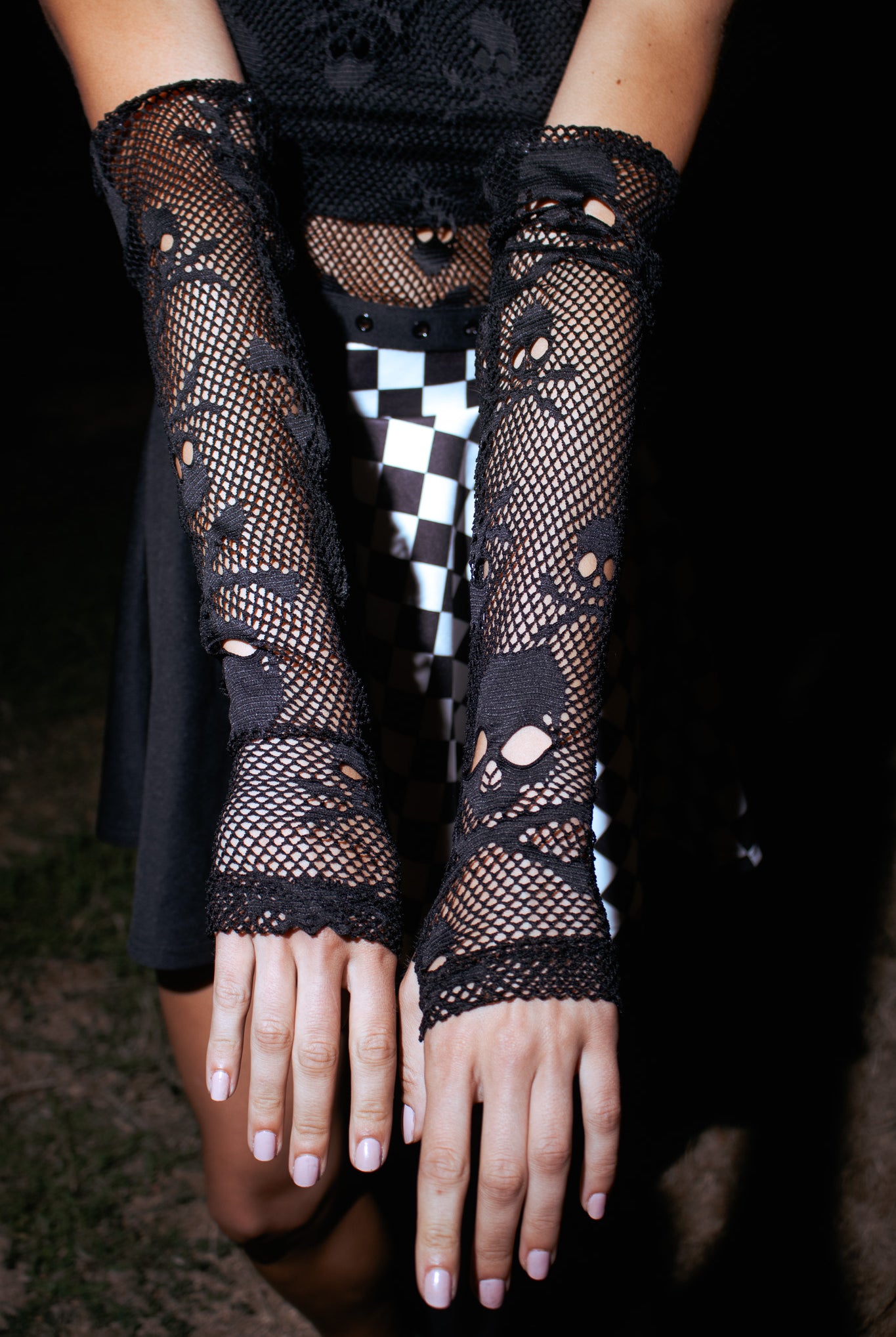
Open-weave sleeves, worn for the line rather than the warmth. Fishnet does nothing thermally and everything visually: it puts a graphic texture on the arm and lets skin through, which is why it reads as club and deathrock rather than winter.
This is also the style that survives a hot venue. A knitted arm warmer in a crowded room is unbearable within twenty minutes; mesh is fine all night. If you are dressing for anywhere with a queue outside and a bar inside, this is the category to shop.
Lace gloves and long lace sleeves
The romantic end. Lace covers the arm without weight, and the longer it runs, the more Victorian the effect gets.
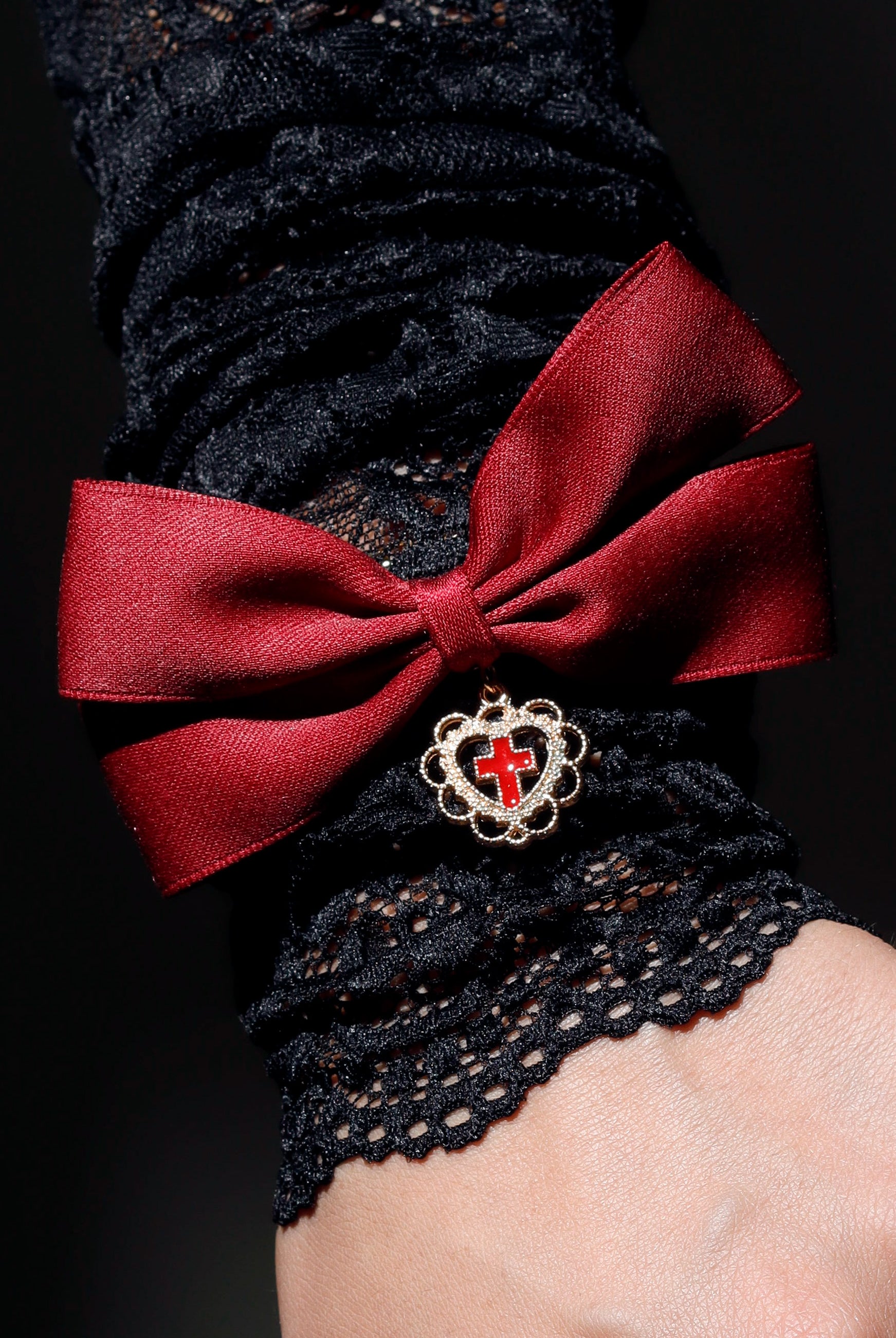
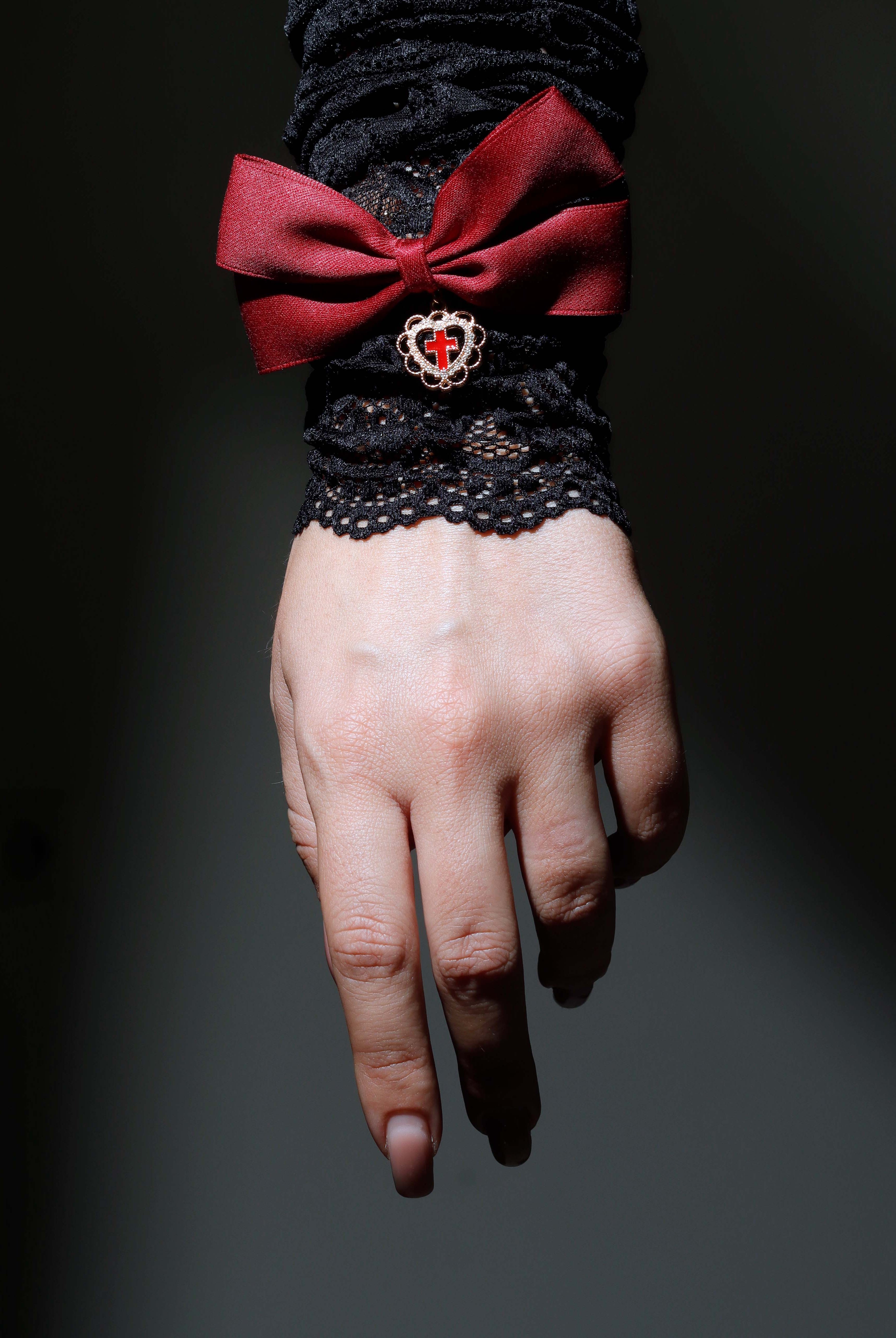
Our Dark Lace Goth Gloves are the long version, in net yarn and nylon with a floral pattern, running to the forearm at 39 cm as listed, $19.99 as listed on 3 September 2026. The Lace Gothic Fishnet Gloves are the short version in polyester, wrist length, at the same price.
Length changes the whole register here. Wrist-length lace is a finishing detail you could wear to work. Forearm lace is a decision, and it belongs with a slip dress and a funeral rather than with jeans.
Fingerless gloves
The most-worn piece in the category, and the one that asks the least of an outfit. The palm is covered, the fingers are free, and you can still use a phone, hold a drink and sign a card.
The variations are all about the motif and the material. Black Cross Fingerless Gloves in polyester, 30 cm long and 7.5 cm wide as listed. Spider Mesh Gloves, also polyester, web-patterned. Silent Torn Gloves, a distressed pair. Skull Knit Gloves in cotton at wrist length, which is the softest option here against skin. Each is $19.99 as listed on 3 September 2026.
At the harder end, the Black/Blue Studded Leather Gloves in nylon, polyester and synthetic leather with a skull pattern, $30.44 to $33.06 as listed on the same date. Studded leather is a different sentence from knitted acrylic. Pick one register per outfit.
Cuffs and wristbands: the short end
Worth naming because they are constantly bought as an arm-warmer substitute and they are not one. A cuff sits on the wrist and does nothing above it.
They are the right answer when the sleeve you are wearing already goes to the wrist and you want hardware rather than fabric. The Spiked 4-Row Wristband in faux leather and zinc alloy with a hidden safety clasp, or the Rebel Gothic Leather Cuff with three rows of spikes and cone studs, both $19.99 as listed on 3 September 2026. If it is texture on the forearm you are after, a cuff will not get you there.
Boleros and shrugs: the layer that is really a sleeve
If what you want is covered arms with a bare shoulder line, the accessory is the long way round and a cropped layer is the short one.
Our Black Gothic Lace Bolero is polyester with full-length sleeves, and it is one of the few pieces in this whole category that publishes real measurements per size: sleeve 63, 64 and 65 cm, shoulder 36, 37 and 38 cm, length 24, 24.5 and 25 cm across S, M and L. The Lacy Crop Top does the same job in a slim, non-stretch halter cut.
Both are $29.71 to $32.76 and $29.85 to $32.31 respectively, as listed on 3 September 2026, which puts them in the same money as two pairs of gloves and covering considerably more.
Which style belongs to which corner of goth
A knitted skull sleeve reads right in one wardrobe and like fancy dress in the next, so it is worth being direct about which goes with which.
Trad goth and deathrock. Knitted arm warmers with a skull or bone motif, fishnet, torn and distressed pieces. Black, high contrast, visibly worn in. Nothing precious.
Romantic goth and gothic romance. Long lace, the bolero, anything that trails. This is the Crimson Peak and gothic romance register, and the sleeve should read as mourning dress rather than as an accessory. We went further into that world in our guide to romantic goth style.
Whimsigoth. Patchwork, texture, colour that is not black. The purple and red patchwork sleeves belong here far more than they belong in a trad wardrobe. Our whimsigoth collection is the wider version of the same instinct, and the difference between this lane and the romantic one is laid out in whimsigoth vs gothic romance.
Dark academia. Almost nothing from this category, honestly. Knitted in a muted grey under a blazer cuff is the only version that works, and even that is borderline. See dark academia fashion for where the effort is better spent.
Corporate goth. Fingerless gloves and cuffs only, and only outside the building. Anything above the wrist reads as costume in an office, which is the whole argument of how to dress corporate goth.
What the materials actually do
Four materials cover almost everything sold in this category, and they behave completely differently for roughly the same money.
Acrylic is the knit. It is warm, it holds a ribbed shape, and it is what nearly every winter arm warmer is made from. It also pills with friction and it does not breathe, so it is a coat-weather fabric and not a dancefloor one.
Polyester is the workhorse for fingerless gloves, mesh and lace. Light, holds a printed or woven pattern, dries fast, and offers no warmth worth counting. Most of the year-round pieces are polyester.
Cotton turns up occasionally, and it is the one to reach for if your skin objects to synthetics. Softer against the wrist, less structured, and it stretches out faster with wear.
Net yarn, nylon and lace blends are the romantic end. Almost weightless, snag on jewellery and on rings in particular, and worth taking off before you do anything with your hands.
The rule underneath all of it: fabric determines the season, not the aesthetic. A skull motif in acrylic and a skull motif in mesh look similar in a photograph and behave like different garments in October. Buy for where you will be standing.
The fit problem nobody mentions
Here is the part the category skips, and we would rather say it than not.
Almost everything in this space is sold as one size. Ours largely are, and so is nearly everything you will find elsewhere. That is not a shrug about it. It is a real limitation, and it lands hardest on the people this industry already serves worst.
A one-size arm warmer is cut to an assumed forearm and bicep, and there is no published circumference on most listings, ours included. Two practical consequences. If your upper arm is larger than the assumed average, an elbow-length knit will sit lower than the photo shows and may grip. If it is smaller, it will slide, and you will spend the evening pulling it up.
What you can do about it, concretely:
- Prefer pieces that publish measurements. Where a listing gives a length and width, as our knitted arm warmers and the bolero do, you can hold a tape to your own arm and know before you buy. Where it gives nothing, you are guessing.
- Prefer sized garments for coverage. A bolero or shrug comes in S, M and L with real numbers behind them. If arm coverage is the actual goal, a sized layer will fit better than a one-size tube.
- Prefer stretch for grip. Knits give. Non-stretch lace does not, and it is the least forgiving thing here.
Our plus-size collection takes a few tops and corsets up to 6XL, and we are not going to pretend a one-size accessory category is inclusive by default. It is the honest weak point of this whole product type, everywhere, and knowing it before you order is worth more than a reassuring sentence.
How to wear them without it reading as costume
Costume happens when everything on the body is talking at once, and the fix is the same across every style above.
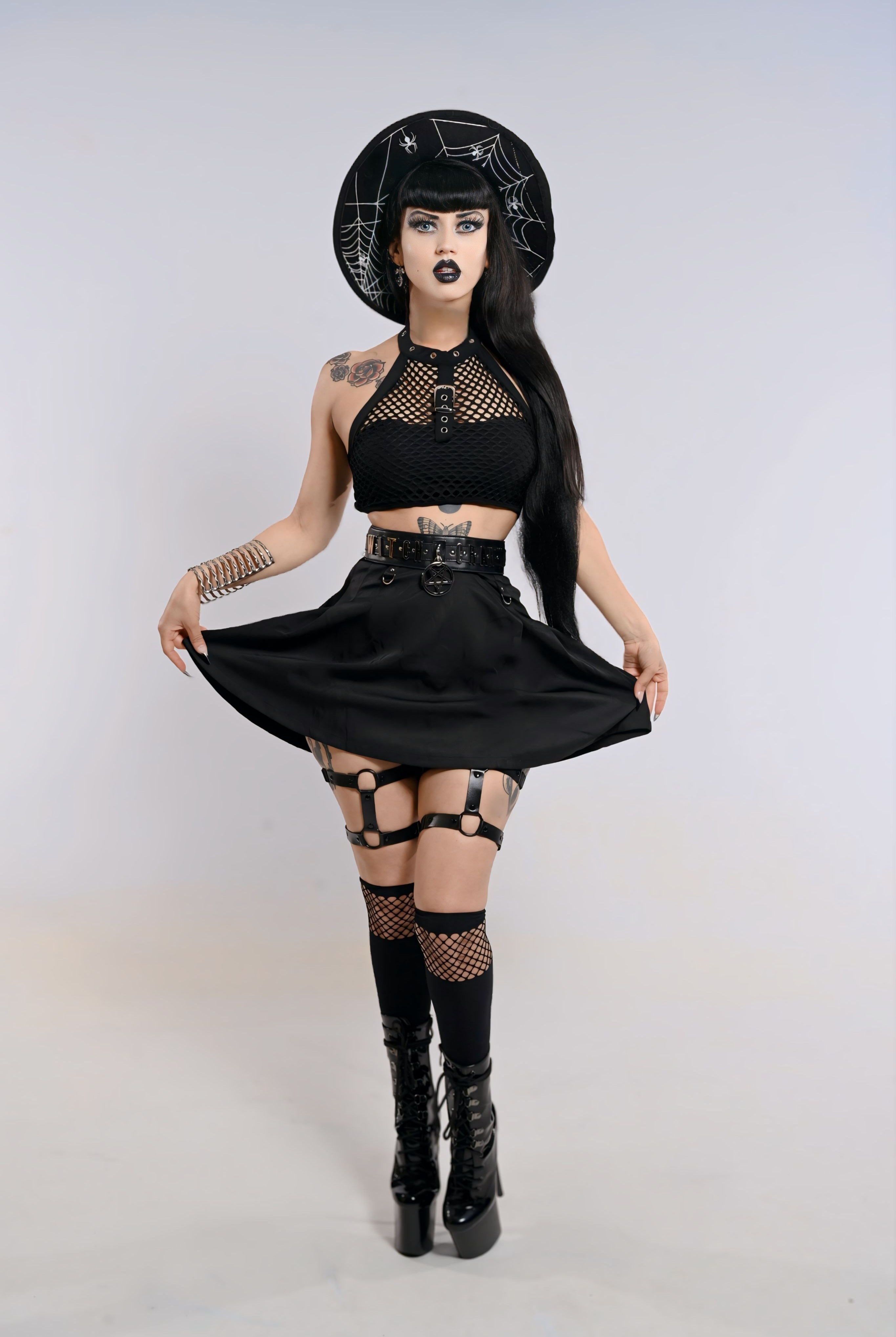
One sleeve piece per outfit. Arm warmers and a harness and a choker and a spiked cuff is a costume shop. Pick the arms or pick the neck.
Match the weight to the garment. A heavy knit over a slip dress fights it. Lace over a knit jumper disappears. Sleeve and garment want to belong to the same season.
Let it end somewhere deliberate. Under a jacket cuff, meeting a short sleeve, or stopping cleanly mid-forearm all read as chosen. Ending randomly halfway down a long sleeve reads as an accident.
Keep the hands quiet. If the sleeve is the loud thing, wear a plain ring or none. If you want the jewellery to talk, keep the sleeve plain. We made the same argument at greater length about layering hardware in how to wear a body harness.
Knitted arm warmers with a short-sleeved dress and boots is autumn, solved. Long lace gloves with a bias slip and nothing else on the arms. Fingerless gloves with a mesh top and a leather jacket, sleeves pushed up so the two textures meet. None of those need any further thought.
Where to buy gothic arm warmers
Where you buy changes what you are told about what you are buying, and the options here are not equivalent.
Marketplaces carry the widest selection and the least information. You will find the shape you want at the price you want, and you will frequently be told nothing about the fabric.
Large alt retailers carry a dedicated category and reliable stock. Selection is broad, the pieces are the same shapes everyone else has, and the listing rarely tells you enough to choose between two near-identical sleeves.
Independent shops are where the curation is. Smaller ranges, and the reason to buy there is that somebody chose the pieces.
That last one is us, so read this accordingly. The Cursed Closet is an independent alternative-fashion brand, founded in 2023 in Tallinn, bootstrapped, creative-director-led, with a handful of tops and corsets cut as large as 6XL. Our arm and hand pieces run from $19.99 to about $33 as listed on 3 September 2026, which is the costume and statement end of the market rather than the heirloom end.
Start with the Gothic Arm Sleeves if you want the patchwork knit, the Black Skull Arm Warmers if you want the winter piece with a motif, and the Dark Lace Goth Gloves if you are dressing romantic. The rest of the small pieces sit in accessories and under $35.
If you want the wider argument about which alt brands are actually independent and how to check, we set it out in our guide to independent goth brands and in independent alternatives to Killstar.
Frequently asked questions
What is the difference between arm warmers and arm sleeves?
In practice, nothing. Both words describe a fabric tube worn from the wrist up the forearm with no hand attached, and shops use them interchangeably. "Arm warmer" is more often attached to knitted winter pieces and "arm sleeve" to mesh, fishnet and lace, but no retailer applies that consistently. What differs between products is length, whether the piece covers the hand, and what it is made from.
What are the best styles of goth arm sleeves?
There are five that matter. Knitted acrylic arm warmers for warmth and a visible motif. Fishnet or mesh sleeves for texture with no heat, which is what survives a crowded venue. Lace, short at the wrist or long to the forearm, for the romantic and Victorian end. Fingerless gloves, the most wearable of the lot because your hands still work. And cuffs or wristbands, which sit on the wrist only and are not a substitute for a sleeve.
How do you style outfits with goth arm sleeves?
Wear one arm piece per outfit and nothing else competing on the arms or neck. Match the weight of the sleeve to the weight of the garment, so knits with knits and lace with lighter fabrics. End the sleeve somewhere deliberate: under a jacket cuff, meeting a short sleeve, or cleanly mid-forearm. Keep rings and bracelets minimal if the sleeve is patterned, and push a jacket sleeve up rather than hiding the piece under it.
What are goth arm warmers made of?
Most knitted arm warmers are acrylic, which is warm, holds a ribbed shape and does not breathe. Fingerless gloves, mesh and most patterned pieces are polyester, which is light and year-round but offers no warmth. Cotton appears occasionally and is the softest option against sensitive skin. Long lace gloves are typically net yarn, nylon or a lace blend, which weigh almost nothing and snag on rings.
Do goth arm warmers come in plus size?
Rarely, and this is the honest weak point of the category. Nearly every arm warmer and glove on the market, ours included, is sold as one size, and most listings publish no arm circumference at all. If coverage is what you want, a sized layer such as a bolero or shrug in S, M or L will fit more predictably than a one-size tube. Where a listing does publish a length and width, measure your own arm against it before ordering.
Are gothic arm warmers warm enough for winter?
The knitted acrylic ones are, under a coat, and that is what they are for. Fishnet, mesh and lace are not warm at any thickness and are not trying to be; they are worn for the texture and the line. If you need actual insulation, buy the knit and treat the mesh as a year-round styling piece rather than a cold-weather one.