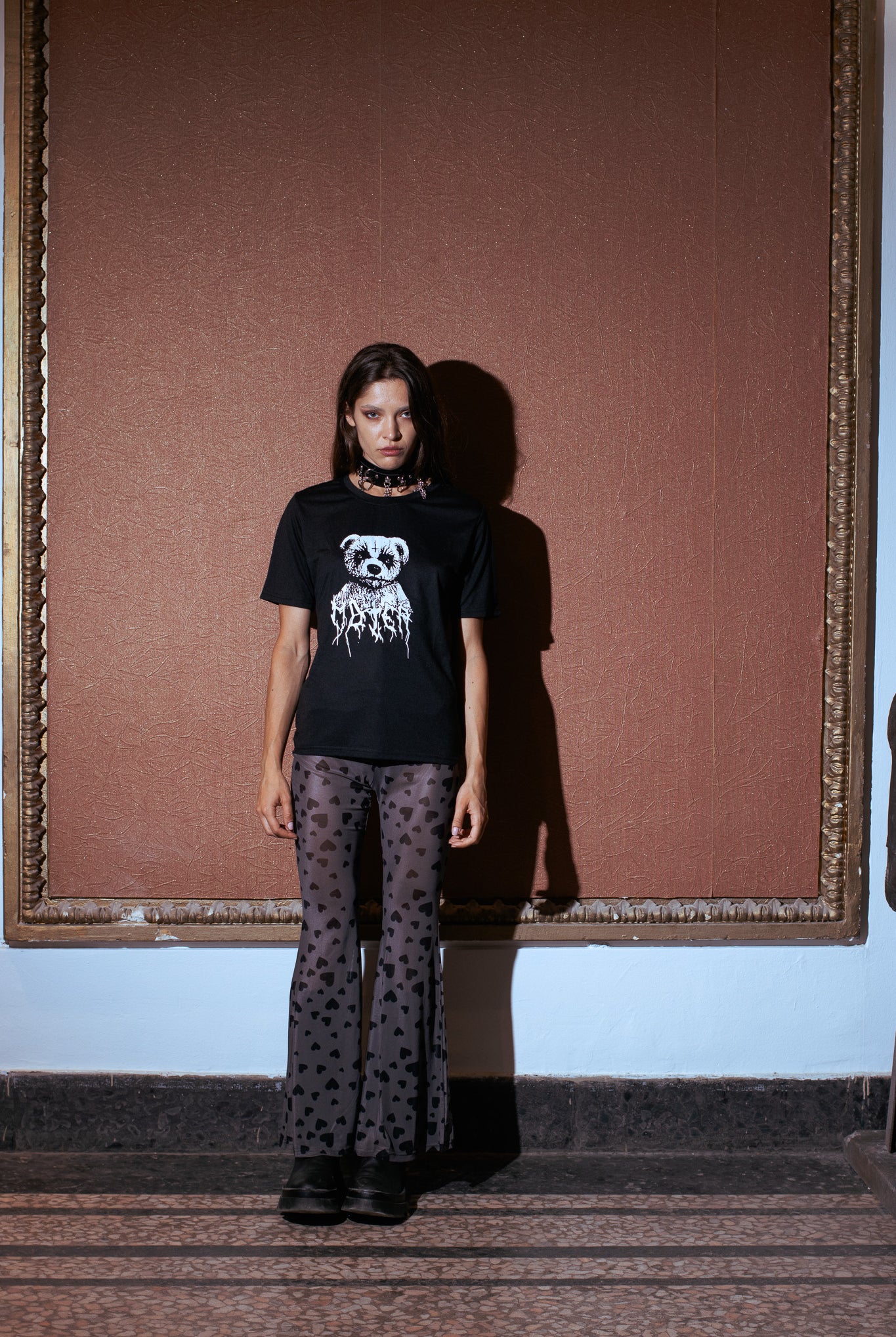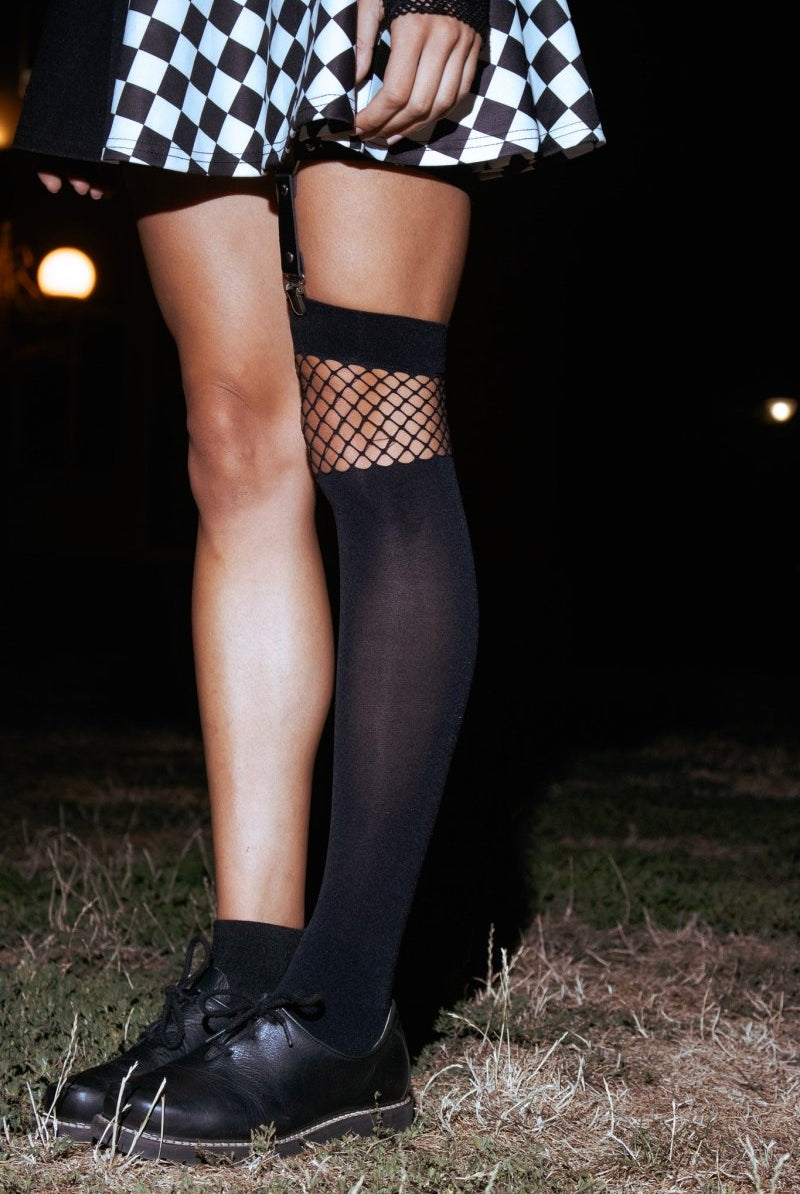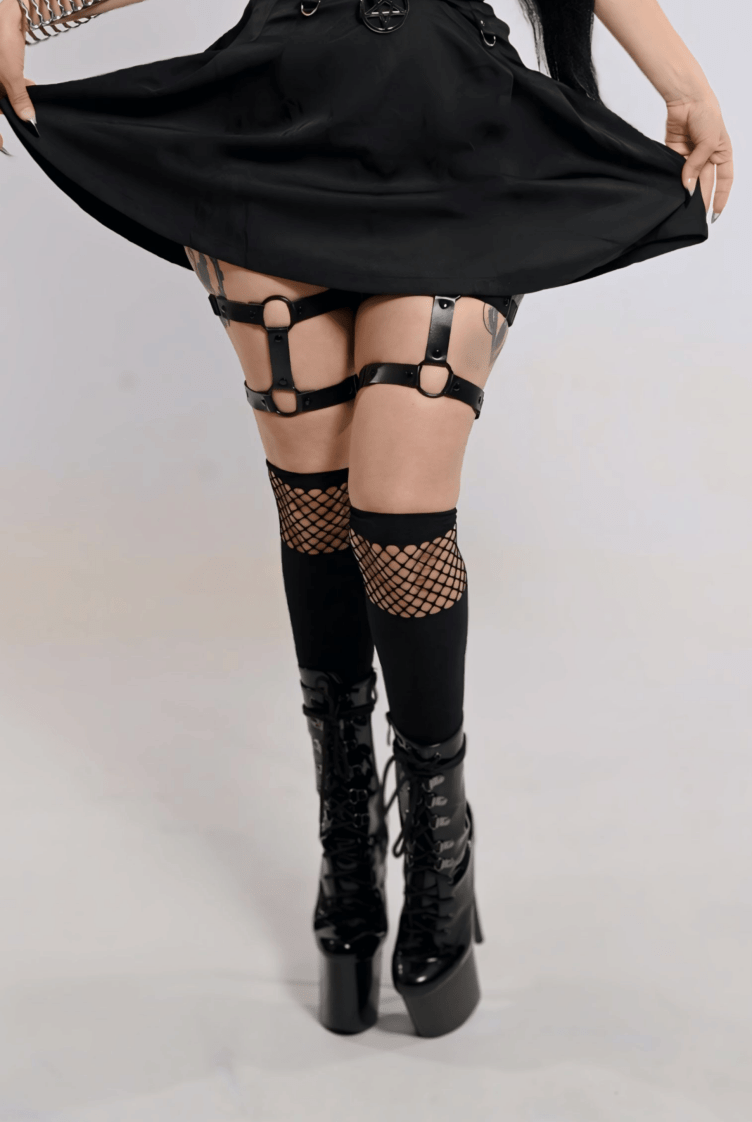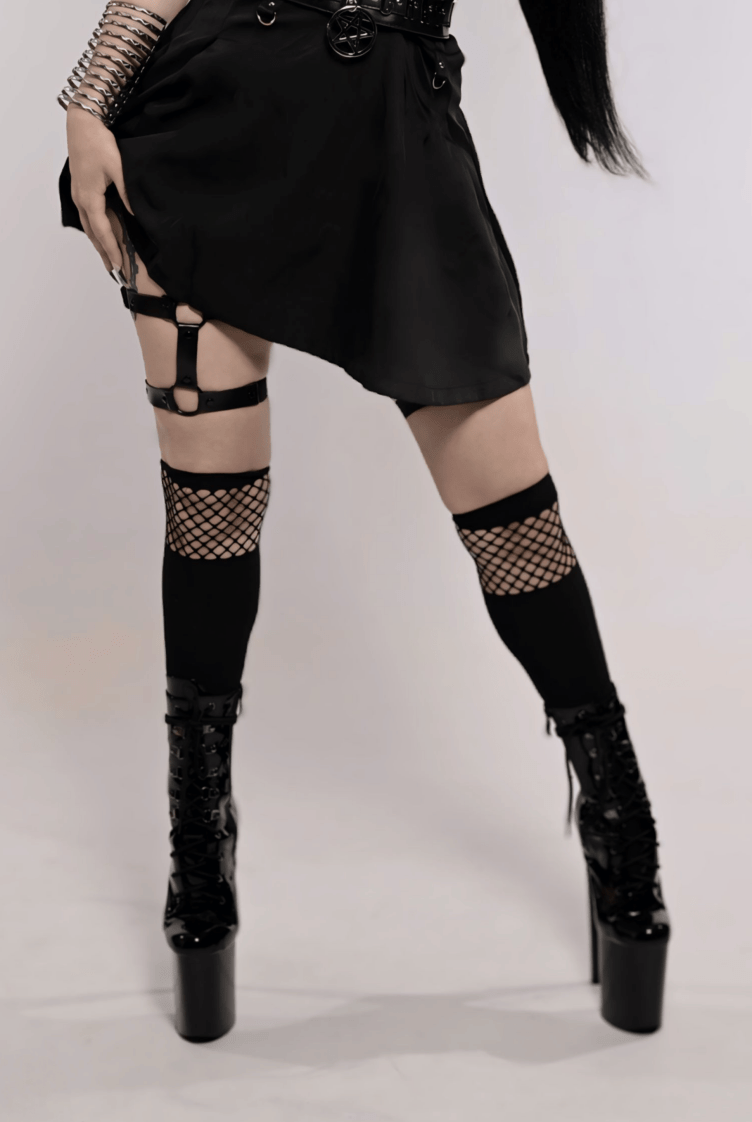
A gothic boot fits a wide calf when the shaft circumference is larger than your calf at its widest point, with room left over for sitting down and for socks. Measure your calf standing and barefoot, at the fullest part, then compare that number against whatever the listing says about the shaft. Shaft height and closure decide more than your shoe size does: an ankle boot has no calf problem at all, and a full lace-up front will adjust where a zip cannot.
If you have ever worked a boot on, got the zip two thirds of the way up and felt it simply stop, you already know your shoe size had nothing to do with it. The boot fitted your foot. It did not fit your leg. Those are two measurements, and most listings only give you one.
This guide gives you the second one, and sets out what our own listings publish and what they do not.
Key Takeaways
- Measure both legs standing and barefoot, at the widest point. The larger leg decides the boot.
- Leave at least 2 cm between that figure and the boot's shaft circumference. A calf widens when you sit.
- Knee-highs often fit a wide calf better than mid-calf boots, which finish at roughly your widest point.
- A full lace-up front is the most forgiving closure. A plain zip is the least.
- Every boot we publish is graded by foot size, not calf width. One states a leg circumference: the Gothic Lace-Up Knee-High Boots, at 34 cm.
Why gothic boots catch wide calves out
The silhouettes this wardrobe is built on work against calf room. A chunky platform boot has a straight, structural shaft that holds its shape, and a shaft that holds its shape will not accommodate a leg. Lace panels, buckles and stud plates stiffen it further.
Sizing does not help you either. Our boots are graded in European sizes from 34 to 43 or US sizes from 4 to 11, and neither system describes your calf, so shoe size is the wrong place to start.
Measure your calf before you shop
Do this once, write the numbers down, and you can read any listing in seconds.
Calf circumference
Stand barefoot with your weight even on both feet, because your calf is at its fullest standing and that is what the boot has to cope with. Run a soft tape up and down and watch for where the number peaks, which for most people sits roughly a third of the way between the floor and the back of the knee. Keep it snug without compressing the skin.
Measure both legs. They are rarely identical, and the larger decides whether a boot closes. Measure late in the day, because legs swell.
Calf height
Measure from the floor to the crease behind your knee, which tells you where a knee-high sits on you rather than on the model. Then measure to the widest point you just found, because that is where any shaft grips hardest.
Your foot, which is a separate problem
Put your heel against a wall, mark the end of your longest toe on paper, and measure in millimetres. Measure across the ball of the foot for width. Both numbers are independent of your calf, and one shoe size cannot express either. Our Black Lace-Up PU Leather Boots publish the full conversion:
| EU size | Foot length | US size |
|---|---|---|
| 35 | 225 mm | 4.5 |
| 36 | 230 mm | 5.5 |
| 37 | 235 mm | 6.5 |
| 38 | 240 mm | 7 |
| 39 | 245 mm | 8 |
| 40 | 250 mm | 8.5 |
| 41 | 255 mm | 9.5 |
| 42 | 260 mm | 10 |
| 43 | 265 mm | 11 |
The number that decides it
Compare your widest calf measurement against the shaft circumference, and leave at least 2 cm spare. That margin is not padding: sit down, measure again, and the figure has grown, because a flexed calf is a wider calf. Socks, tights and the boot's own lining take the rest.
Most listings give no shaft measurement at all, and then shaft height and closure are your only signals.
Shaft height changes the question entirely
How far the shaft rises decides whether your calf measurement matters at all.
Ankle boots
An ankle boot finishes below the calf, so calf width never enters into it. If you have been losing fights with boot zips, this is the reliable route, and it is no aesthetic compromise: the platform and the heel do the work, and the shaft was never the point.
Our Black Goth Ankle Boots sit on an 8 cm heel with a 3 cm to 5 cm platform, graded EU 35 to 43. The Gothic Black Platform Boots are also ankle height, stating true to size, sizes 4 to 10, European 34 to 42.
Mid-calf boots
Mid-calf is the hardest height for a wide calf and the one most people try first. The shaft finishes at roughly the fullest part of the leg, so the boot's tightest point and your leg's widest point meet, and the extra width has nowhere to go.
The Black Lace-Up PU Leather Boots above state mid-calf, and the Black Goth Platform Boots state mid to upper calf or knee. Here the lace or zip does all the work, so read the closure carefully.
Knee-high boots
A knee-high can be the easier buy. The shaft passes your widest point and carries on to the narrower stretch below the knee, so it is not trying to finish where your leg is fullest. Knee-highs also lace the whole way up more often.
Here we can give a real number. The Gothic Lace-Up Knee-High Boots state a 35 cm leg height and a 34 cm leg circumference, about 13.8 inches tall and 13.4 inches around. They lace the full front, sit on a 9.5 cm square heel with a 3.5 cm platform, and are graded US 4 to 11. The shaft is PU with a short plush lining, worth knowing before you add thick socks.
Closure is the best predictor on the listing
When a listing gives no measurements, the closure tells you most of what you need to know.
A full lace-up front is the most forgiving thing a boot can offer. You set the circumference, you can set it differently at ankle and calf, and you can let it out later. The knee-high above laces the full length, as do the Gothic Lace-Up Leather Boots on a PU shaft.
A plain zip is the least forgiving, because the circumference is fixed at manufacture and nothing about wearing the boot changes it. The Black Cobweb Boots close with a zip and state true to size, take your normal size. The Black Goth Platform Boots also close with a zip. Both are good boots and neither will negotiate.
A lace-up front with an inner zip is the better arrangement, because the zip gets you in and out while the laces hold the fit.
Buckle straps are usually decorative, sitting on a shaft that closes some other way, so check whether the strap passes through the shaft or merely across it.
Materials that give, and materials that do not
Every boot we publish that names its shaft or upper names PU or patent. That is a fit fact rather than a detail, because a coated synthetic shaft will not stretch, mould or relax around your leg the way an unfinished leather one slowly does. A boot like this that does not close on the first evening will not close on the thirtieth. Nothing is breaking in.
Linings cut the same way: a short plush lining like the one in our knee-high is welcome in November and is taking up room your calf was going to use.
Plus size is not one measurement
Plus size gets used as though it describes one thing, and in footwear it describes three: how long your foot is, how wide your foot is, and how wide your calf is. You can need room in one and not the others, which is why a plus-size filter so often returns pairs that still do not work.
Foot width is the part our listings address. The Black Studded Goth Boots carry explicit guidance to choose one size larger for wide feet, and are graded EU 35 to 43 with heel to toe measurements from 22.5 to 26.5 cm.
Sizing up sometimes buys a little shaft room too, but do not rely on it: shaft circumference does not grade as predictably as foot length, and a boot that is too long slips at the heel.
One thing to be clear about, because the naming invites the wrong assumption: our plus size collection is clothing, reaching 6XL on some pieces, and it holds no footwear. If you came there for boots, the boots collection is the right door.
What our listings publish, and what they do not
We would rather set this out than let you discover it by disappointment.
Every boot we publish is graded by foot size only. Shoe size and colour are the two choices on the page, and there is no width option, no wide-calf variant and no calf grading on any pair we sell. Of the twenty-three boots published in our collection on 9 September 2026, exactly one states a leg circumference: the Gothic Lace-Up Knee-High Boots, at 34 cm.
What the rest publish is still worth using. Shaft height appears as a word rather than a number, so ankle, mid-calf and knee-high are reliable, and "mid to upper calf" is telling you the boot is ambitious. Heel to toe measurements in centimetres appear on several, and those beat a size label when you are choosing between two sizes.
Our size chart covers clothing rather than footwear, so foot conversions live on individual product pages. The table above comes from one of those listings and is the most complete we publish.
What to do when a boot will not close
Stop pulling. A zip forced over a calf that is too wide is a zip that breaks, and a broken zip is not returnable the way an unworn boot is. If it does not close on the first try, send it back.
On a genuine lace-up, re-lace before you give up. Skipping the top two eyelets, or lacing so the laces cross fewer times over the calf, opens a shaft by more than people expect. Do not count on stretching: a cobbler can do useful work on a leather shaft and very little on a coated synthetic one.
Then change the shape of the problem instead of the boot. Drop to ankle height, where calf width stops mattering, or go up to a knee-high with a full lace front. Both keep the silhouette.
And if what you need is a boot engineered for a wide calf from the start, with the shaft graded as its own measurement, that is a question about brands rather than fit. We have answered it in our guide to the best goth boots for women.
Frequently asked questions
How do I know if boots will fit my calves?
Measure both calves standing and barefoot at the widest point, take the larger figure, and compare it against the shaft circumference on the listing with at least 2 cm spare. If no measurement is given, read the closure: a lace-up front adjusts, a plain zip does not.
What goth boots are good for wide calves?
Ankle boots, because calf width does not apply to them, and knee-highs that lace the full front, because you set the circumference. Mid-calf boots with a plain zip are the hardest combination, finishing at roughly your widest point with no way to let it out.
Do The Cursed Closet boots come in wide calf?
No. Every boot we publish is graded by foot size only, with colour and shoe size as the two options, and there is no wide-calf variant or width grading. One pair states a leg circumference, the Gothic Lace-Up Knee-High Boots at 34 cm. For the rest, shaft height and closure are what you have to go on.
What is the widest calf a knee-high boot here fits?
The Gothic Lace-Up Knee-High Boots, at a 34 cm leg circumference and 35 cm leg height, about 13.4 inches around and 13.8 inches tall. It is the only knee-high we publish with a stated figure, and it laces the full front, so the usable range is a little wider than a fixed shaft.
Should I size up in goth boots if I have wide feet?
On some pairs yes, and one of ours says so directly: the Black Studded Goth Boots advise choosing one size larger for wide feet. Check the listing rather than assuming, because sizing up adds length too, and a boot that is too long slips at the heel.
Start with your own numbers
Boots are the foundation of this wardrobe and the piece most often bought on hope. The fix takes five minutes: measure both calves at the widest point, note the height to that point, and keep the numbers on your phone. After that, every listing either answers your question or visibly fails to.
For the rest of the outfit, goth style for beginners covers the order to buy in, and our alt lingerie and goth underwear guide takes the same line on sizing.