A Victorian mourning dress was a plain black dress in a fabric with no shine, worn for a set time after a death and lightened by stages. A widow began in dull wool or bombazine covered with crape, under a long crape veil, and ended eighteen months to two years later in grey, lavender or black and white.
That is the short version. The longer one is stranger.
The etiquette manuals that laid down the rules could not agree on them, and the women who wrote those manuals complained about the clothes. One called crape "a most costly and disagreeable material". Another printed a recipe for scrubbing the black off your arms.
This guide goes back to those manuals and to the dresses that survive in museum collections. It covers what the cloth was, who wore which stage and for how long, where the real ones are kept, and what to look for if you want the look now. If you are here for the wardrobe more than the history, the last section is yours, and our gothic romance collection is where we keep the lace.
Key Takeaways
- A Victorian mourning dress was defined by a dull surface more than by its cut: wool, bombazine and crape first, and silk only once it was "perfectly lusterless".
- A widow wore the deepest stage. American manuals of 1881 and 1887 give her eighteen months to two years, and a London manual of 1916 still lists two years as the longest period.
- White came back at the collar and cuffs in second mourning. Grey, purple, lilac or black and white marked half-mourning.
- There was never one rulebook. In 1860 Florence Hartley wrote that there was "no rule either for the depth of mourning, or the time when it may be laid aside".
- We do not sell a reproduction mourning gown. Three garments on our rail borrow from the later stages, and all three stop at L.
What was a Victorian mourning dress?
A Victorian mourning dress was an ordinary dress of its year, made up in black cloth with no gloss and almost no trimming, and worn to show that the wearer had lost a relative. The cut followed fashion. The surface is what made it mourning.
The V&A's records make both points. One of its mourning dresses, dated 1845 to 1850, is catalogued as "lustreless black silk satin". Another began life in the 1840s and was altered in the 1860s, with fabric added below the waist "to accommodate the wide 1860s skirts". It was kept and remade as skirts grew wider, like any other good dress.
Mourning clothes were not only for the widow. The V&A's note on a length of mourning silk records that Victorian etiquette "demanded that upon a death the whole household went into black", children and servants included, and that how severe the mourning was depended on how close the relationship had been.
Why is it called widow's weeds?
"Weeds" is an old word for clothes. The Online Etymology Dictionary traces it to Old English wæd, a garment, and dates the phrase "widow's weeds" to the early fifteenth century. By the early nineteenth century the word was archaic, and it survives in this one expression.
What were Victorian mourning dresses made of?
They were made of wool, or wool and silk, with a matte face, then trimmed or covered with crape. Florence Hartley's Ladies' Book of Etiquette (1860) lists "bombazine, Parramatta cloth, delaine, barege, or merino". Our Deportment, an American manual of 1881, asks for "the heaviest black of serge, bombazine, lustreless alpaca, delaine, merino or similar heavily clinging material".
Crape
Crape is the fabric most tied to mourning. The 1911 Encyclopaedia Britannica describes it as "a silk fabric of a gauzy texture, having a peculiar crisp or crimpy appearance", and says the hard kind was "almost exclusively dyed black and used in mourning dress". The spelling is the English form of the French crêpe.
The crimp was put in after weaving, by a finishing process the Britannica says was known "to only a few manufacturers, who so jealously guard their secret". It names Braintree in Essex, Norwich, Yarmouth, Manchester and Glasgow as the British centres, and notes a cotton imitation sold as Victoria crape.
A widow wore a great deal of it. Mrs John Sherwood, whose Manners and Social Usages was copyrighted in 1884 and revised in 1887, wrote that in America a widow's first mourning dresses were "covered almost entirely with crape". She did not admire it: it was "easily ruined by the dampness and dust", and "very ugly and very expensive".
Bombazine and the black wools
Under the crape sat a dull wool or wool-and-silk cloth. Good bombazine, in the Britannica's definition, has "a silk warp and a worsted weft" and is twilled or corded. By 1911 the same entry could add that black bombazine "has been used largely for mourning, but the material has gone out of fashion".
Sherwood names the alternatives her readers were turning to because they cost less than crape and were kinder to wear: Henrietta cloth and serge for winter, and tamise cloth, grenadine and nuns' veiling for lighter dresses. All of them had what she called the "dead black, lustreless look".
Black silk, once the shine was gone
Silk came in at the second stage, and only without gloss. Our Deportment is firm on it: "Mourning silks should be perfectly lusterless, and the ribbons worn without any gloss."
The V&A holds the proof that this was a trade as well as a custom: a length of black dress silk from about 1890, still in the printed paper wrapper of Peter Robinson's Mourning Warehouse in Regent Street. It was bought by the yard, the record explains, to be made up by the customer's own dressmaker.
What was left off
Deep mourning was as much about what was missing. Our Deportment forbids flounces, ruffles and bows, rules out jewellery, and requires that "all pins, buckles, etc., must be of jet". Kid gloves were excluded too. Gloves were to be "of cloth, silk or thread".
Lace was the other casualty. Sherwood puts it in four words: lace is never mourning. She insists that even the French, who "have very light ideas on the subject", kept it off their dresses until half-mourning.
The dresses are less tidy than the manual. The V&A has a French mourning dress of the 1890s, in black silk, whose neckline is trimmed with ribbon and Chantilly lace.
The stages of Victorian mourning dress
Mourning dress moved through three broad stages: deep mourning, second mourning and half-mourning. Each one gave something back, first white at the neck and wrists, then trimming, then colour. This table follows Our Deportment (1881), which splits the last stage into two degrees that are folded together here.
| Stage | The dress | Head, neck and hands | Colours |
|---|---|---|---|
| Deep mourning | Heavy dull wool or bombazine, crape collar and cuffs, little or no trimming | Crape bonnet, crape veil, black gloves, black-bordered handkerchief, jet pins only | Black |
| Second mourning | Lustreless alpaca or black silk trimmed with crape | Net or tulle veil in place of crape, white collars and cuffs, jet jewellery | Black with white |
| Half-mourning | Trimming returns, and crape is kept only on the bonnet before it goes altogether | At the end, a black lace bonnet with white or violet flowers, jet and gold jewellery | Black and white, purple, grey, lilac |
The manuals disagree about the last stage. Hartley, in 1860, has a woman finish in "a white bonnet, shawl, and light purple or lavender dress". Sherwood reported from America that the "gradations of gray, purple, or lilac have been abandoned" in favour of black and white, only a few years after Our Deportment had listed all three colours.
The surviving dresses show both fashions. The V&A has a bodice and skirt of about 1890 in black and mauve striped silk, catalogued as an example of half-mourning. It also has a Paris day dress of 1889 to 1892 in ivory silk with black velvet ribbon and black lace, described as "probably a half-mourning dress". That one was worn by Cara or Anne Rogers, the daughters of an American industrialist, and the museum suggests it marks the death of their sister Millicent, who died in 1890 aged seventeen.
Mauve itself was new. The V&A's note on the striped dress points out that the colour only became widely available for fabric after mauveine and other artificial dyes were discovered in the 1850s.
How long did Victorians wear mourning?
A widow wore mourning longest, for eighteen months to two years depending on the manual and the country, and other relatives were mourned for a year or less. Our Deportment prints the fullest scheme, which it credits to an unnamed authority.
| Mourning for | Total time | How it was divided |
|---|---|---|
| A husband | Two years, "sometimes longer" | A year in black wool with crape and a long veil, then silk trimmed with crape, with grey, violet and white in the last six months |
| A parent or a child | One year | Six months in wool with crape, three in black silk, three in grey, purple and violet |
| A grandparent | Six months | Three months in black wool, six weeks in silk, six weeks in grey, purple, white and violet |
| A brother or sister | Six months | Two months each in black with crape, black silk, and the lighter colours |
| An aunt, uncle, niece or nephew | Three months | Second mourning from the first day |
Read that as one manual's answer. Sherwood gives two in the same book: widows wear deep mourning "for about two years, and sometimes for life", and in the next chapter a widow's mourning "should last eighteen months, although in England it is somewhat lightened in twelve".
The British figures were at least as long. Manners and Rules of Good Society, a London manual in its thirty-eighth edition by 1916, gives two years as the longest period for a widow and eighteen months as the shorter one. It adds that crape was formerly worn "for one year and nine months", and that the widow's cap and veil were worn for "a year and a day".
Both American writers admit the rules were soft. Our Deportment opens its section by saying the people of the United States "have settled upon no prescribed periods" for mourning. Hartley says the same in 1860. The tables were a guide for people who wanted one.
Who wore what?
The widow wore the most, but mourning attire reached the whole household and the guests at the funeral.
Widows: The marks of a widow were the cap and the mourning veil. Sherwood describes a bonnet with a long crape veil and "a widow's cap of white crape if preferred", the cap left off after twelve months and the heavy veil exchanged for a lighter one. Worn down, she writes, the widow's veil "covers the entire person".
Children: For children under twelve, Our Deportment prescribes white in summer and grey in winter, with black trimmings, belt, sleeve ruffles and bonnet ribbons.
Men: Men got off lightly. Sherwood notes that widowers wore mourning for two years in England and one in America, and went back into society far sooner than widows. The 1916 London manual gives widowers one year.
Servants: Sherwood says servants were usually put in mourning for the head of the family, in plain black livery. The V&A's black and mauve striped dress is believed to have been worn by Sophia Lewis, a housekeeper in a Mayfair household, and the museum thinks it was probably made at home.
Guests: Women invited to a funeral were expected to wear black "even if they are not in mourning", according to Our Deportment. A wedding was the opposite case. The same manual says no guest should attend an evening wedding reception in mourning dress, "which should give place to grey or lavender", and Sherwood records English widows wearing deep red to a son's or daughter's wedding. Black as a colour to marry in belongs to a separate history, which our goth wedding dress guide follows.
What did Queen Victoria's mourning dress look like?
Queen Victoria's mourning dress was black, worn with a widow's cap, a cottage-shaped mourning bonnet and, at court, a long white veil down her back. That is how Sherwood describes it in the 1880s, more than twenty years into the queen's widowhood. "Her widow's cap has never been laid aside," she writes, and adds that the whole English nation had "commended her black dress".
The dates are in the 1911 Britannica: the Prince Consort died at Windsor on 14 December 1861, and the queen died on 22 January 1901, thirty-nine years later. LancasterHistory, in Lancaster, Pennsylvania, rounds her time in mourning dress to forty years.
A mourning dress dated 1862, the year after the prince died, is in the London Museum. It is made of wool, silk and cotton. Its record names Victoria as a related person without saying who wore it. The painter Sir Joseph Noel Paton had it for a memorial portrait of the Royal Family in mourning beside a marble bust of the Prince Consort. "To the Queen's displeasure," the record notes, "the picture was never finished."
What mourning dress cost the wearer
Mourning was expensive, uncomfortable and, by the manuals' own account, bad for the health. Hartley warns that the best crape and woollen cloth cost a great deal, and that buying cheap was worse, because cheap mourning goods "wear out and grow rusty so soon".
The dye came off. Hartley notes that women in mourning in warm weather were "much incommoded by the blackness it leaves on the arms and neck", and prints a remedy made with oxalic acid, which she labels as poison in capital letters. It is a record of the problem and nothing to copy.
Sherwood's complaint is the veil. It "harms the eyes and it injures the skin", she writes, and she reports doctors advising thin nuns' veiling in its place. She still sees the point of the dress: for a woman in deep grief it is "a wall, a cell of refuge" against the cheerfulness of strangers.
Shops grew up to supply all of it. The V&A's record of the Peter Robinson silk says the firm's mourning branch was nicknamed "Black Peter Robinson's", that its assistants advised customers on the right level of mourning, and that it served everyone from the middle classes to the upper ranks of the working class.
Where can you see a real Victorian mourning dress?
Three museums catalogue surviving dresses online: the V&A and the London Museum in London, and the Metropolitan Museum of Art in New York. These are the records worth an hour of your time.
- V&A, T.52-2002, 1845 to 1850. Lustreless black silk satin, a bodice that ends in a long point at the front and is held by fan-shaped boning, and a skirt gathered with cartridge pleats.
- V&A, T.107:1, 2-2003, about 1900. A wool bodice and A-line skirt, trimmed with chevrons of mourning crape around the hem.
- V&A, T.53-2002 and T.4:1,2-2015. The remade 1840s dress and the black and mauve half-mourning dress described above.
- London Museum, 54.137/1, 1862. The dress tied to Paton's unfinished royal portrait.
- London Museum, 74.304/1a, 1876 to 1878. A boned bodice in black ribbed silk trimmed with black crepe, its long sleeves and high neckline edged with white gauze ruffles.
- The Met, 2009.300.673a, b, 1872 to 1874. An American mourning dress in silk and cotton.
- The Met, 2009.300.1157a, b, 1894. A British mourning dress in silk. Both Met dresses came from the Brooklyn Museum's costume collection.
Search the numbers before you travel. The London Museum's record gives no display location for the 1862 dress, and the Met's records give no gallery number for either of its two.
When did people stop wearing mourning dress?
The rules loosened in the early twentieth century and gave way during the First World War. The 1916 edition of Manners and Rules of Good Society says the periods of mourning "have within the last few years been materially shortened", and that "the time-honoured custom of wearing crape has greatly declined".
A 2008 paper by S. A. Bedikian of New York University, in the journal Omega, places the break at the war. With so many women working and so many deaths, the paper says, it became impractical to observe the seclusion that formal mourning called for, and the mourning clothes of those years were modest and practical. In the decades after, the custom shrank to dark colours worn for up to a year.
How to wear a Victorian mourning dress now
A Victorian gothic dress in the mourning style needs the three things that made the originals read as mourning: a black with no shine, a covered line, and one stage's rules for trim and colour. Nobody needs a crape veil for it.
Start with the surface: A matte black reads as mourning and a glossy one reads as evening wear. Judge the fabric in daylight where you can. Our black gothic dresses guide goes through how different black fabrics behave.
Then cover the line: The London Museum's 1870s bodice has long sleeves and a high neckline, and the V&A's French dress has a long skirt with a short train. Sleeves that reach the wrist, and a neckline that is closed or filled, do most of the work.
Choose a stage: No trim and no jewellery for deep mourning. White at the collar and cuffs for second mourning. Grey, mauve, lilac or black and white for half-mourning.
Finish with fabric gloves: The manuals wanted cloth, silk or thread at the hands, never kid.
Here is where goth and the Victorians part company. Goth kept the outline and the palette of mourning and reversed its rule about surface. Velvet appears in none of the three manuals' lists for deep mourning, and lace was ruled out.
Those are two of the fabrics goth loves most, and our own rail is full of them. What we wear now sits much closer to second mourning and half-mourning than to a widow's first year.
What we sell that borrows from it
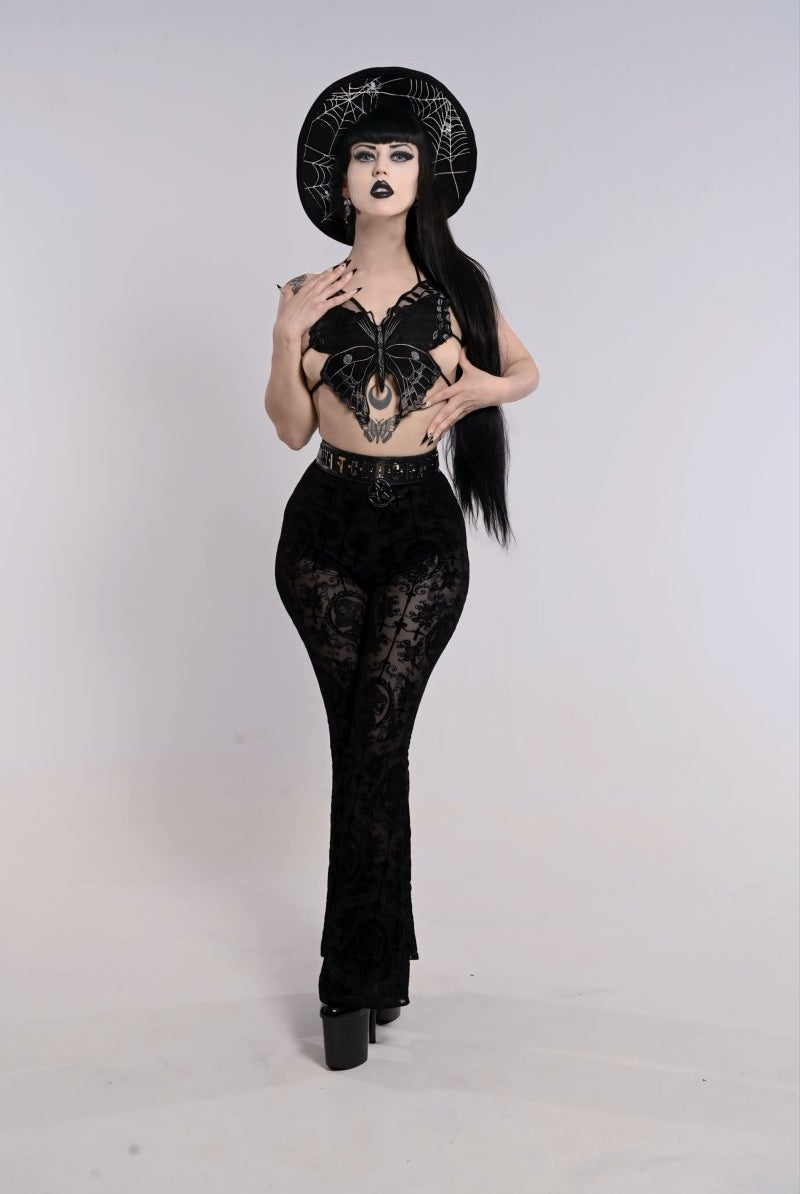
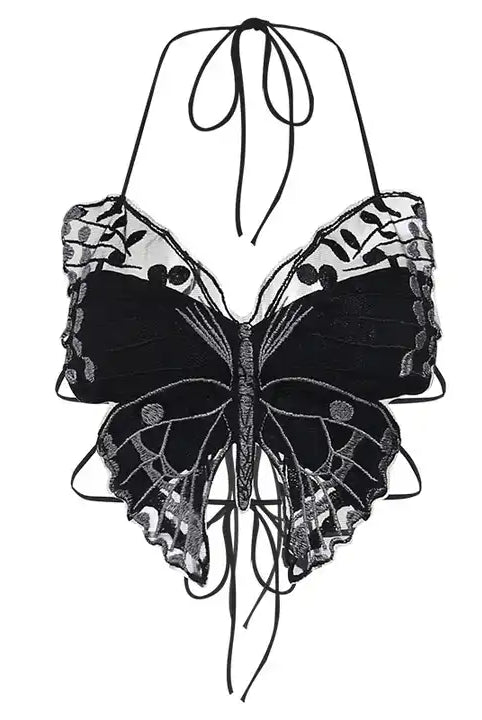
We are not a costumier. We sell no reproduction mourning gown and no antique one, and we have no plain, high-necked, floor-length black dress to point you to. Three garments borrow from the later stages, and every one of them stops at L.
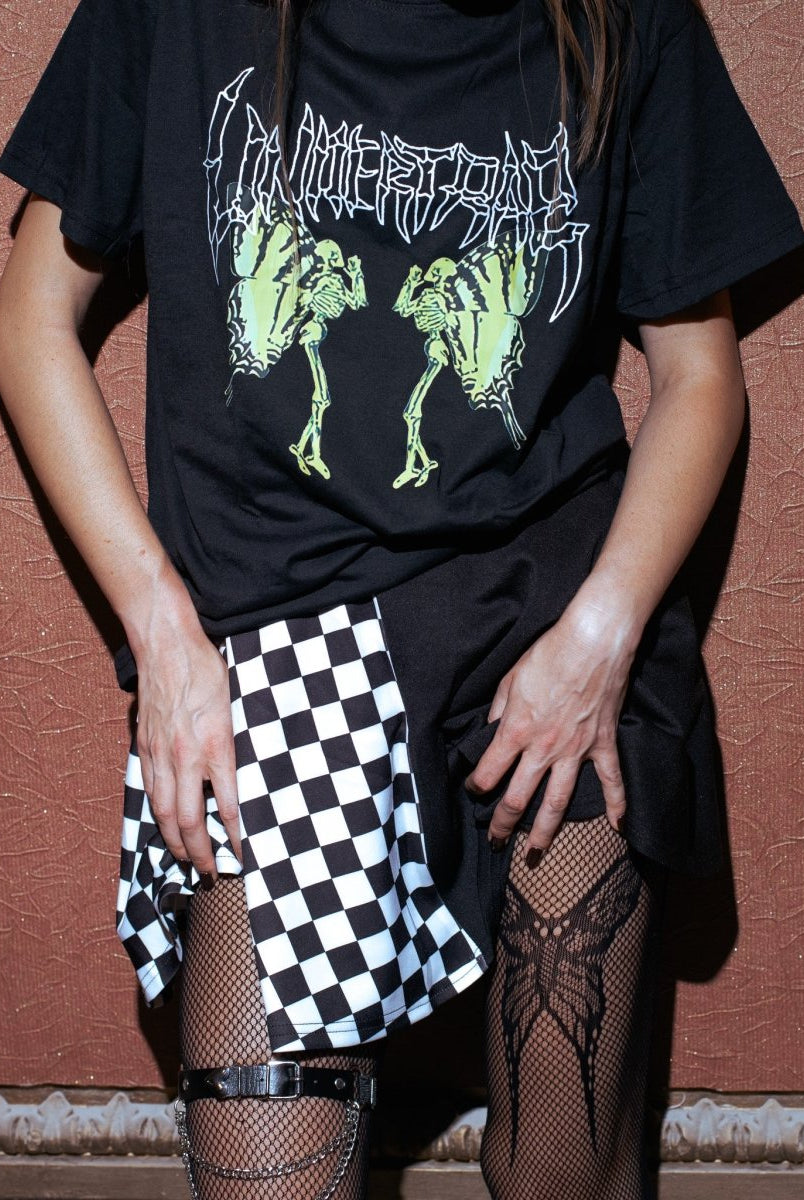
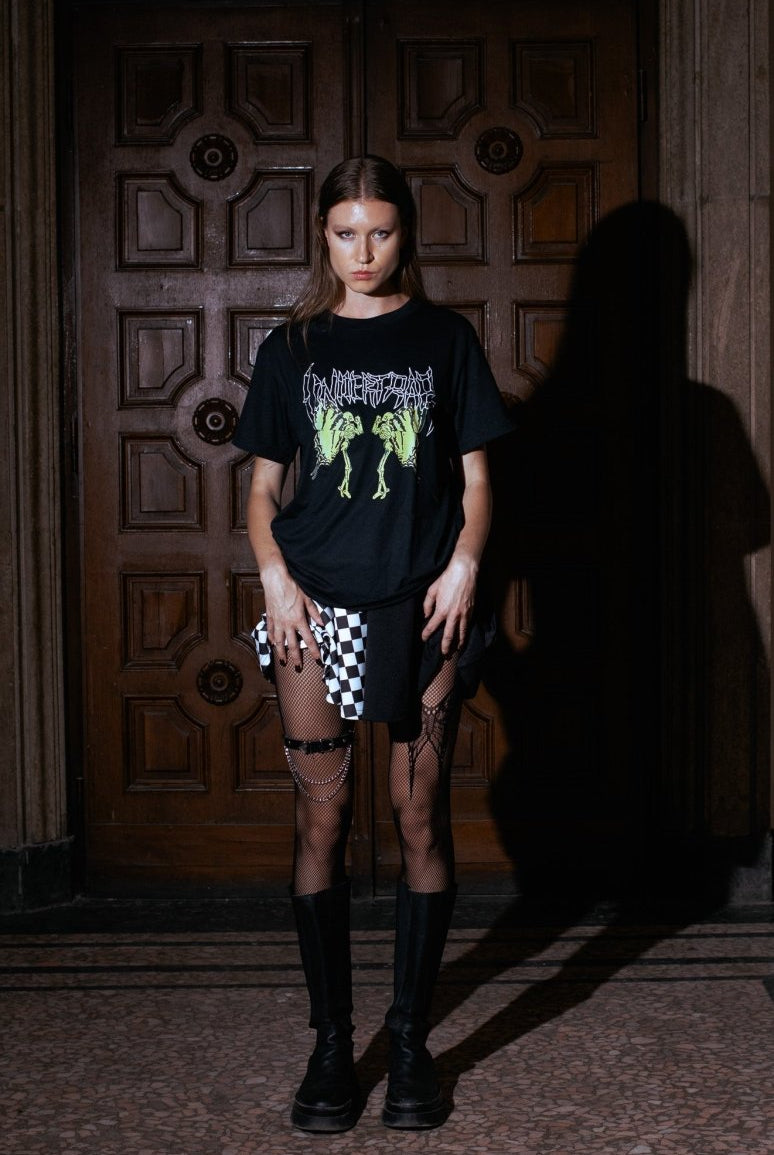
Second mourning: The Velvet Widow Dress is black velvet with white lace at exactly the places second mourning put white: around the neckline and at the cuffs of its long sleeves, with more showing under the hem. It is short: on a 5'4" model in S it ends above the knee. It costs $51.99 in XS/S, M and L, and sits in our Whispers of the Ruin collection.
Half-mourning: The Belladonna Skirt is a narrow black skirt to the ankle, with a spray of violet and blue flowers climbing from a sheer hem. Black lightened with purple is the half-mourning idea in one garment. It is $54.99 in S, M and L, and the model is 5'8" in S.
Above it, the Mystic Veil Top is a sheer purple floral mesh blouse with a deep V neckline, a bow at the centre and wide bell sleeves, $42.99 in S, M and L, modelled at 5'8" in S. It needs a black layer underneath. Both pieces belong to our Moonlit Amethyst collection, which holds the rest of the purples.
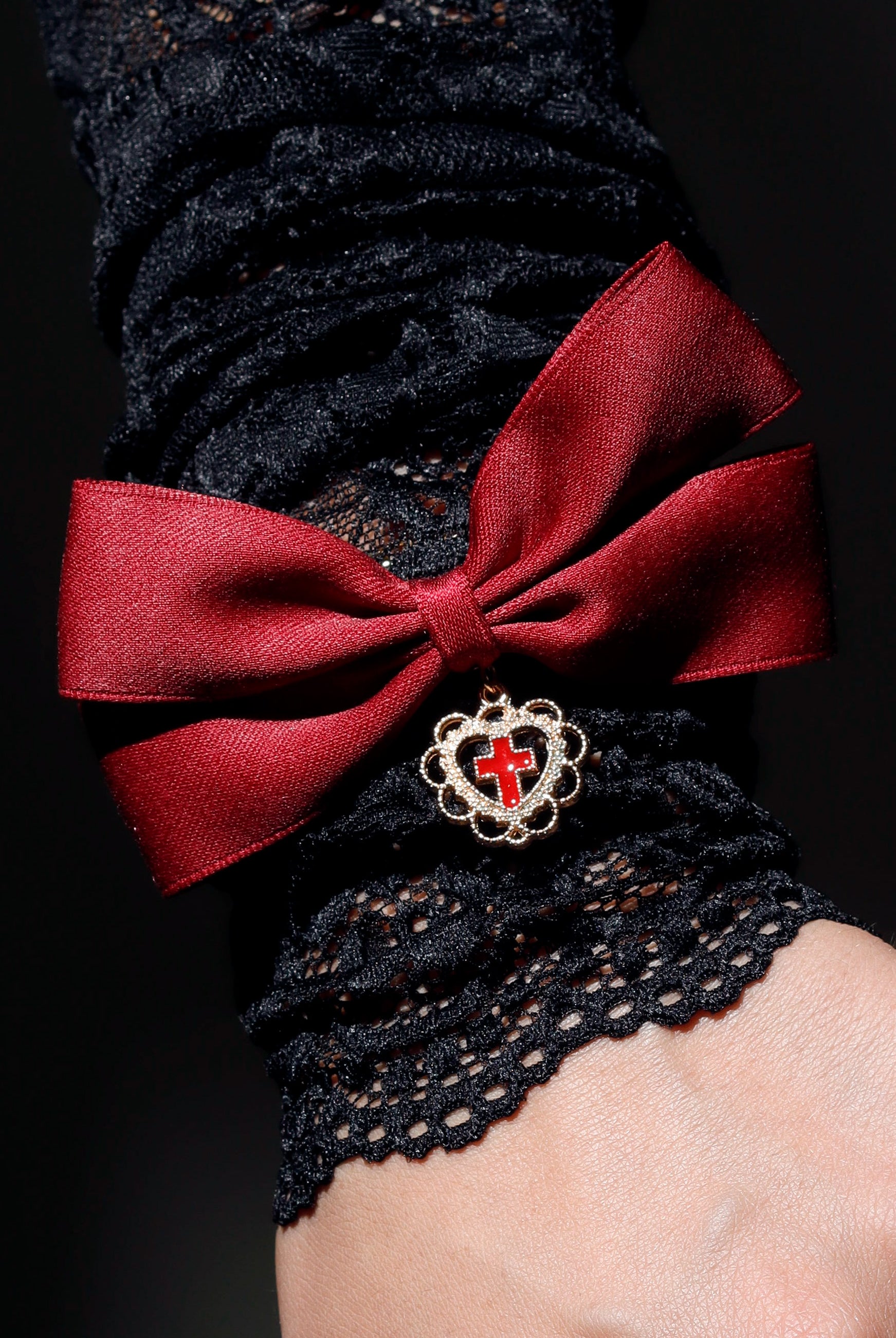
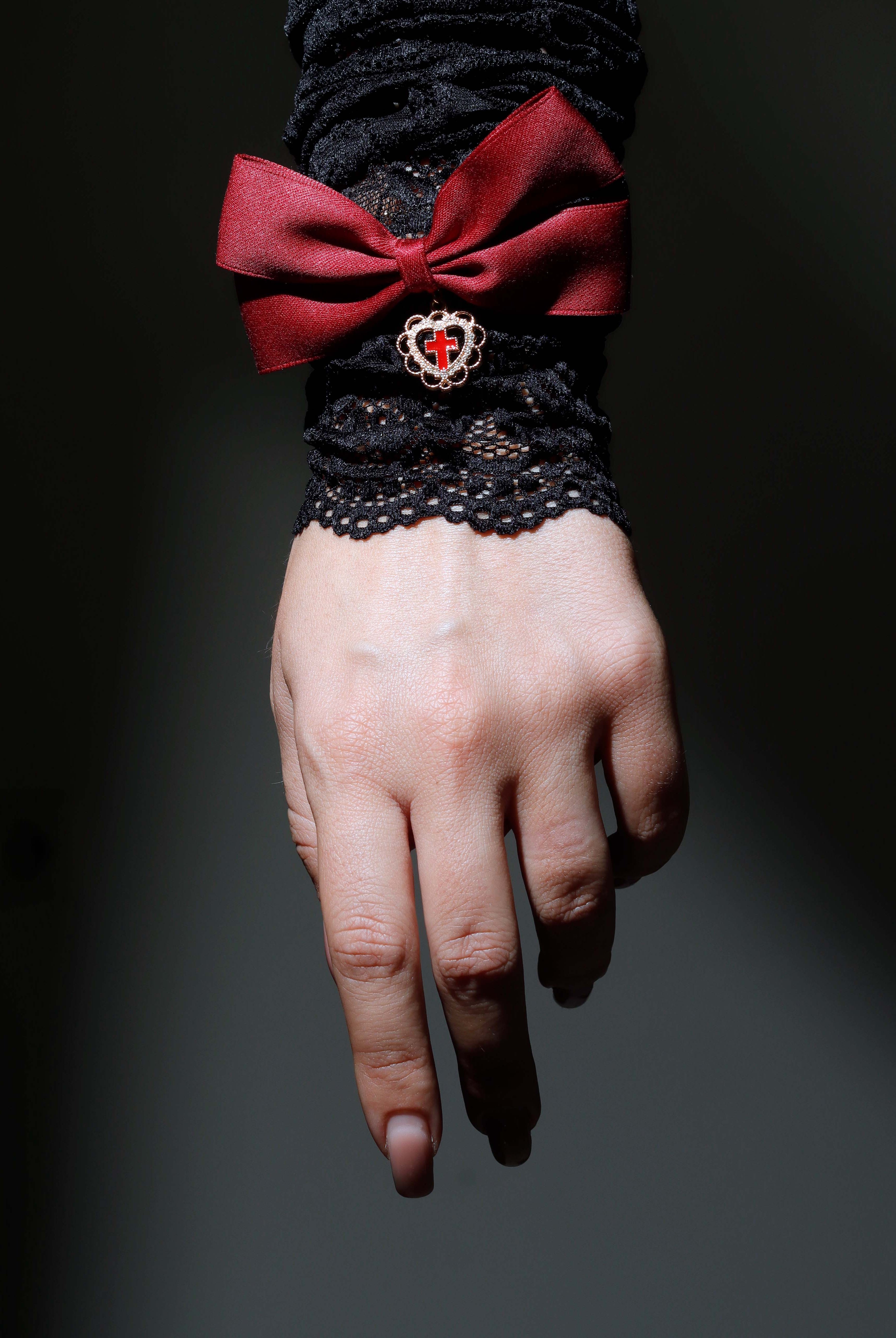
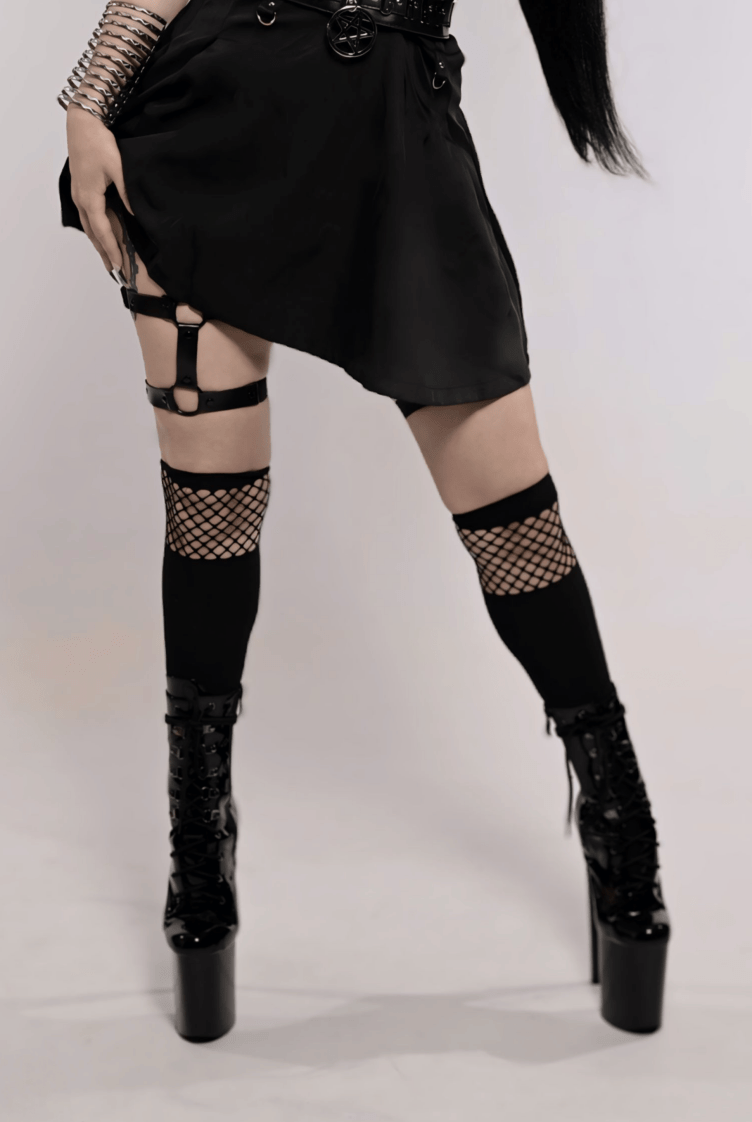
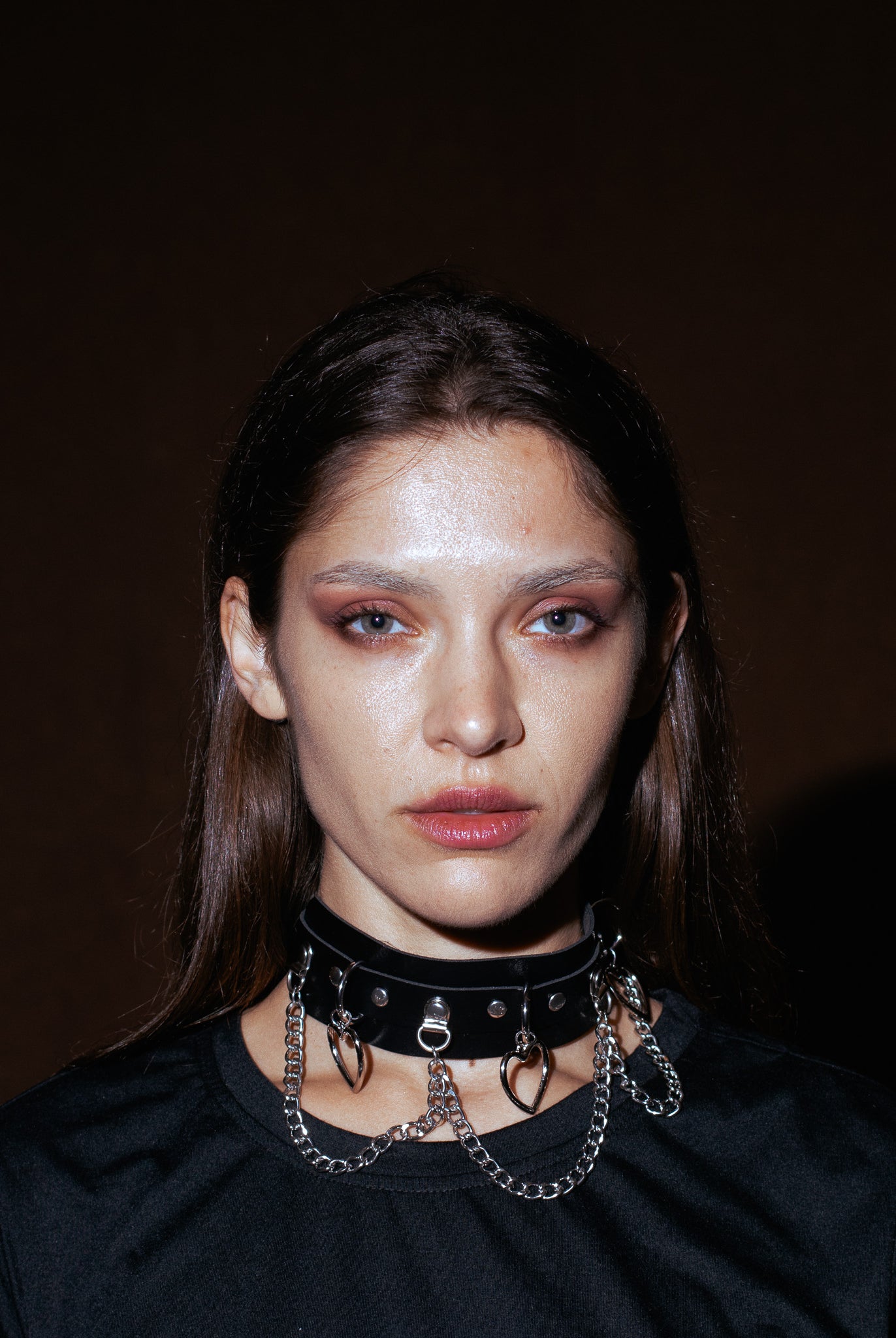
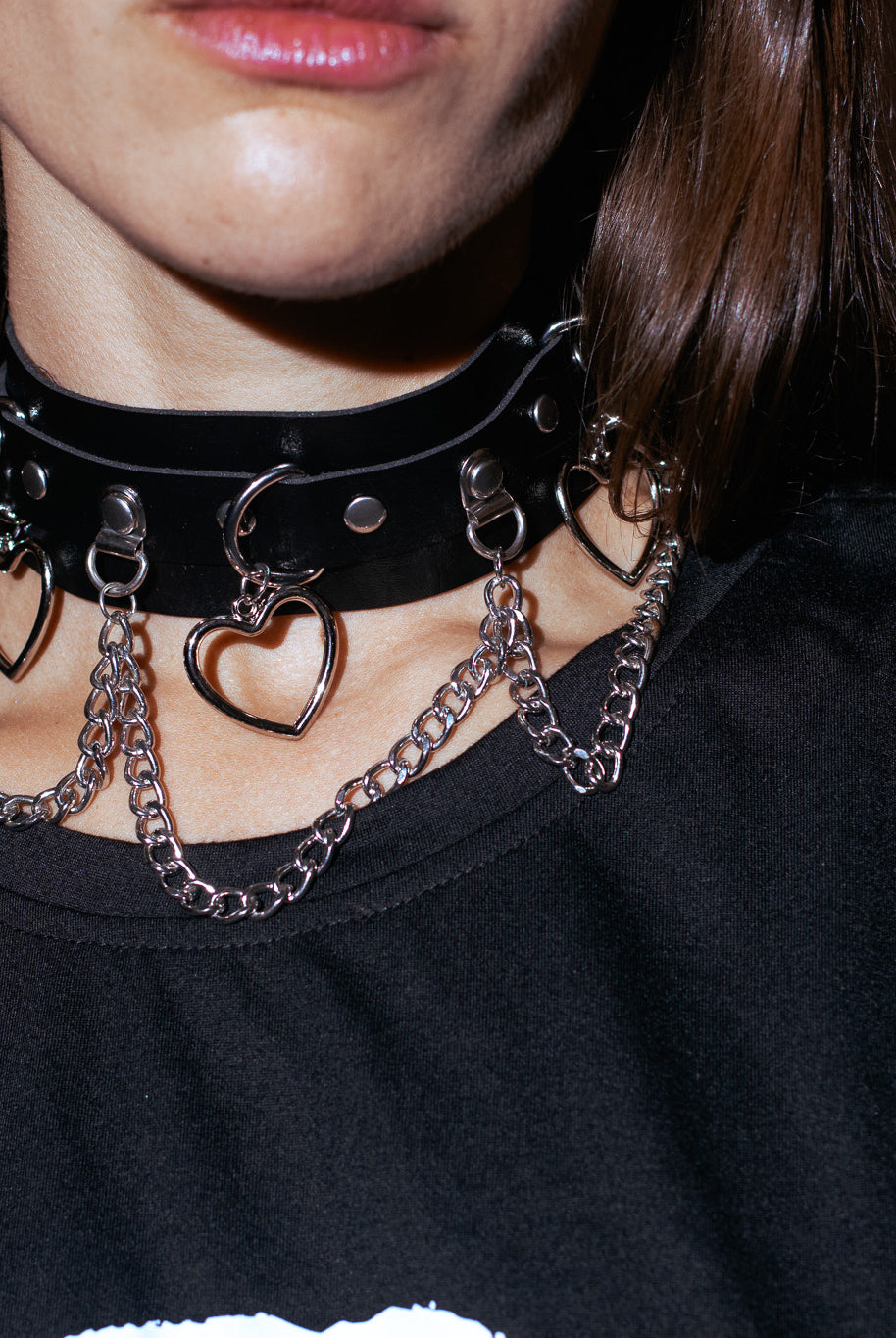
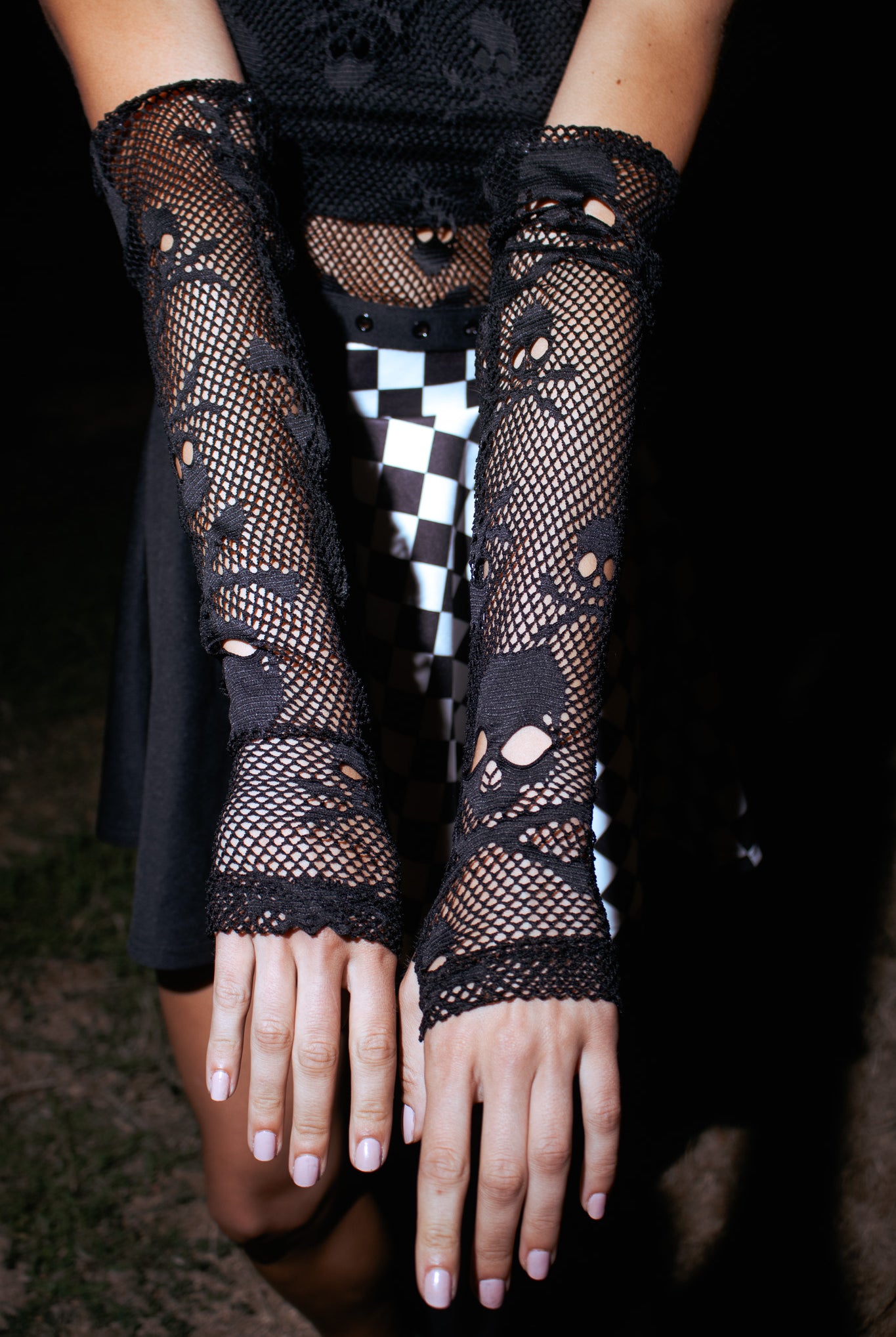
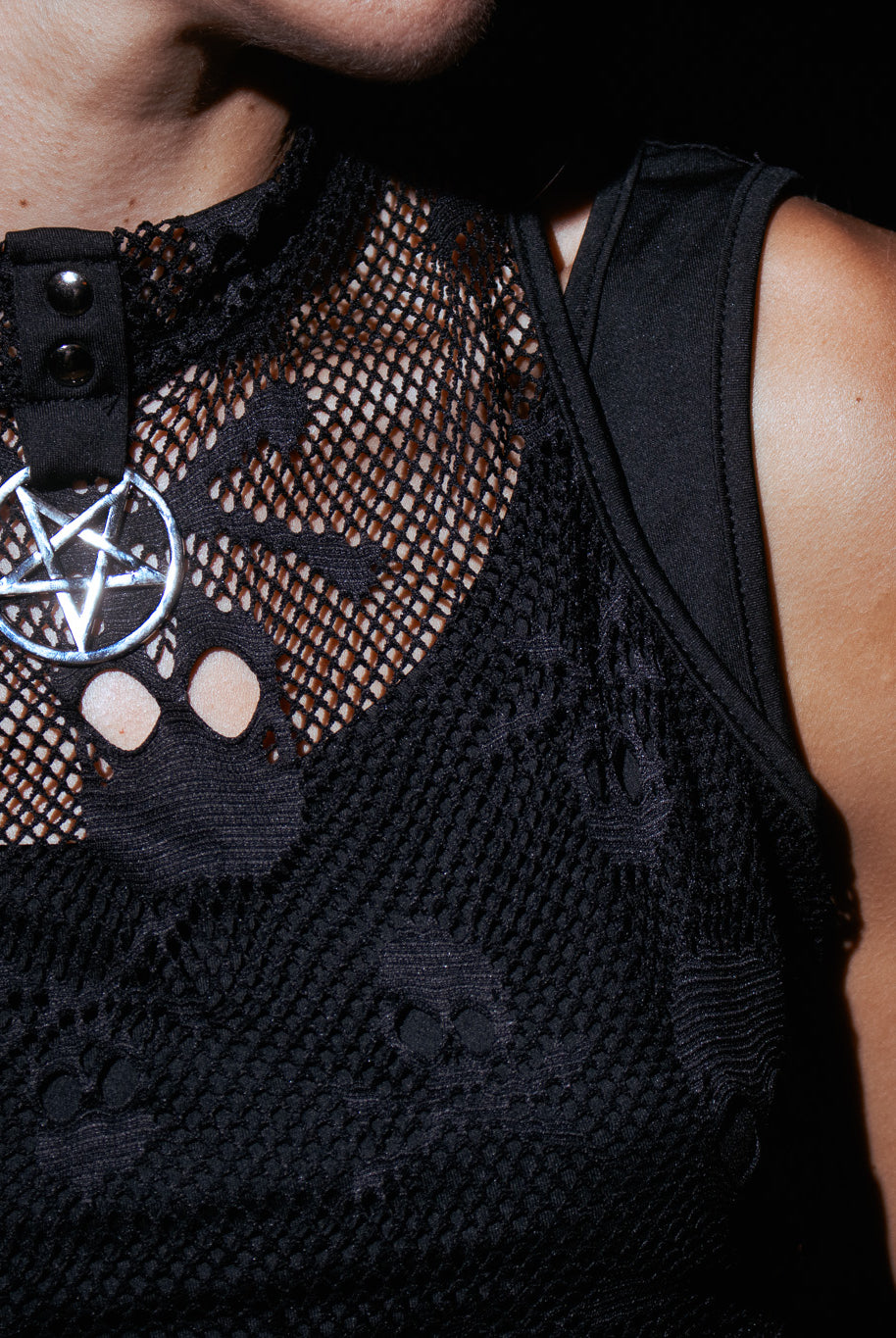
Throat and hands: The Ruffled Cross Choker is a band of black lace ruffles with a black cross pendant, fastened by an adjustable chain, $27.99. The Lace Gothic Fishnet Gloves are wrist-length black fishnet, finished at the cuff with a lace frill and a tiny bow, $19.99. Neither has a size. For other gloves and tights, see our goth accessories guide.
For the all-black first stage, with a closed collar, a shaped waist and a long skirt, our Victorian goth outfit guide builds the silhouette from separates. The longer gowns are in our gothic dresses collection.
If you want a Victorian mourning costume for the end of October, the look works because it is clothing and not a character. Our goth Halloween outfit guide explains how to keep it wearable.
Frequently asked questions
What is a Victorian mourning dress called?
A widow's version was known as widow's weeds, from an Old English word for a garment. The general terms in period manuals are simply "mourning", "deep mourning" for the strictest first stage, and "half-mourning" for the last and lightest one.
What fabric was used for Victorian mourning dresses?
Matte black cloth: bombazine, serge, merino, alpaca and Henrietta cloth, with crape as trimming or as a covering over the dress. Silk was accepted later on, provided it had no lustre. Crape was a crimped silk gauze, and by 1911 the hard kind was dyed black and sold almost wholly for mourning.
How long did a Victorian widow wear black?
Between eighteen months and two years, by the books we read. Our Deportment says two years or more, Mrs Sherwood says eighteen months in one chapter and about two years in another, and the London manual of 1916 prints both figures as its shorter and longer periods.
What colours could you wear in half-mourning?
Grey, purple, violet, lilac, lavender and white, alone or combined with black. In the 1880s Mrs Sherwood reported that American women had dropped the purples for black and white. Museum dresses in black and mauve stripes and in ivory and black show both habits.
Is a Victorian mourning dress the same as a funeral dress?
No. A funeral dress is for one day, and a mourning dress was worn for months or years afterwards. The 1881 manual asks any woman invited to a funeral to come in black whether or not she is in mourning herself, so the two overlapped only on the day.
Can you buy a Victorian mourning dress from The Cursed Closet?
Not historical ones. We carry a black velvet dress with white lace at the neck and cuffs and two purple pieces in the half-mourning palette, all in sizes up to L, plus an unsized lace choker and gloves. For a period-accurate gown you need a historical costumier.